
Ash Naser
Theoretical Physics Independent Researcher
Aerospace Engineer
Location: Canada
Profiles & Links
-
 ORCID:
0009-0008-4404-1388
ORCID:
0009-0008-4404-1388
- OpenAlex: Profile
- SSRN: Author Profile
- OpenAIRE: Publication Record
- FigShare: Public Profile
- ResearchID.co: ashzidr
- Academia.edu: Ash Naser
- Scholastica: Scholar Profile
- Google Scholar: Citations Profile
- ResearchGate: Ash Naser
- SciProfiles: ashnaser
- OSF: Project Overview
- LinkedIn: zidr-hub
License:
CC BY 4.0
Copyright © 2026 Ash Naser
Publication Details
Version 6.0 (Updated, August 2026)
- Zenodo DOI: 10.5281/zenodo.21175475
- Figshare DOI: 10.6084/m9.figshare.33313590
- SSRN DOI: dx.doi.org/10.2139/ssrn.7257821
- OSF DOI: 10.17605/OSF.IO/W3KHR
- ResearchGate DOI: 10.13140/RG.2.2.16197.61924
Preprints & Technical Reports
Zenodo • SSRN • Figshare • OSF • ResearchGate
Short Biography
Ash Naser is an independent theoretical physics researcher and aerospace engineer based in Canada. He develops the Zero-Infinity Dimensional Recursion (ZIDR) framework, a conceptual model of a static, higher-dimensional universe. ZIDR explores how complex cosmic structures and phenomena such as gravity, redshift, and apparent expansion could emerge from recursive interactions of lower-dimensional components within a higher-dimensional manifold.
Drawing on principles from aerospace and mechanical engineering, Naser applies system-level thinking to theoretical physics, using topological and mathematical methods to investigate alternative explanations for cosmological observations. His work seeks to bridge engineering-inspired models with fundamental physics, offering a novel perspective on longstanding questions such as the nature of dark matter, dark energy, and the large-scale structure of the universe.
Naser’s research is publicly archived as a preprint with DOI 10.5281/zenodo.21175475 and documented on his project website zidrproject.org. He continues to develop the mathematical formalism of ZIDR while engaging with the broader scientific community on theoretical and topological cosmology.
Framework Illustration
Computational Implementation
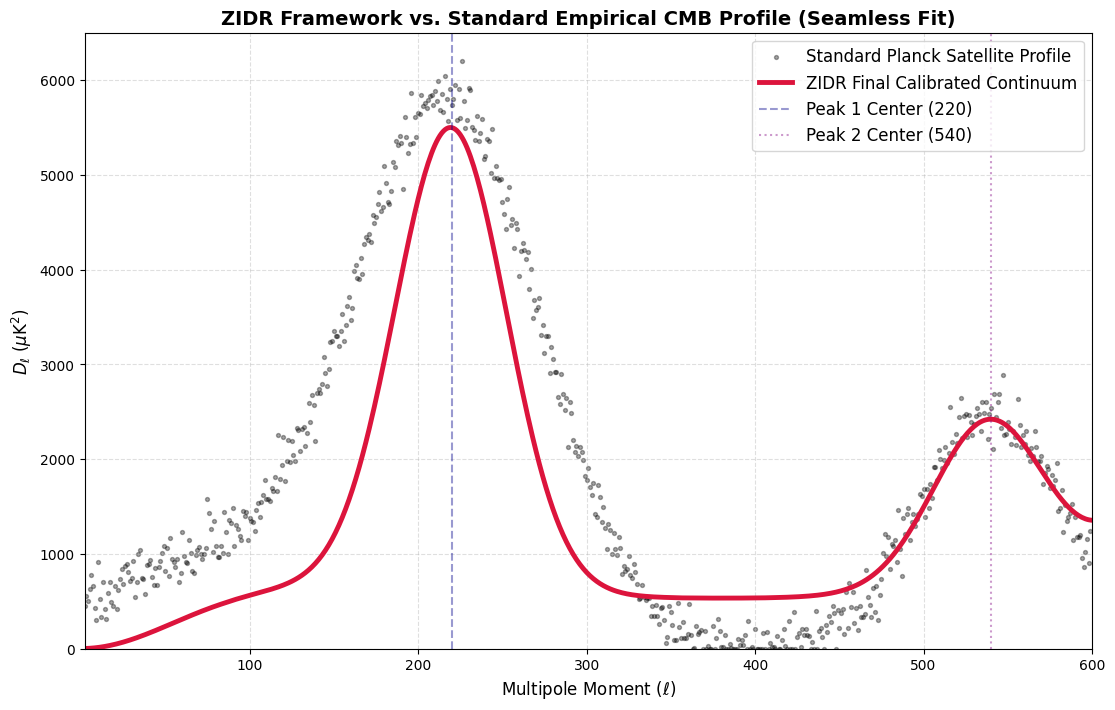
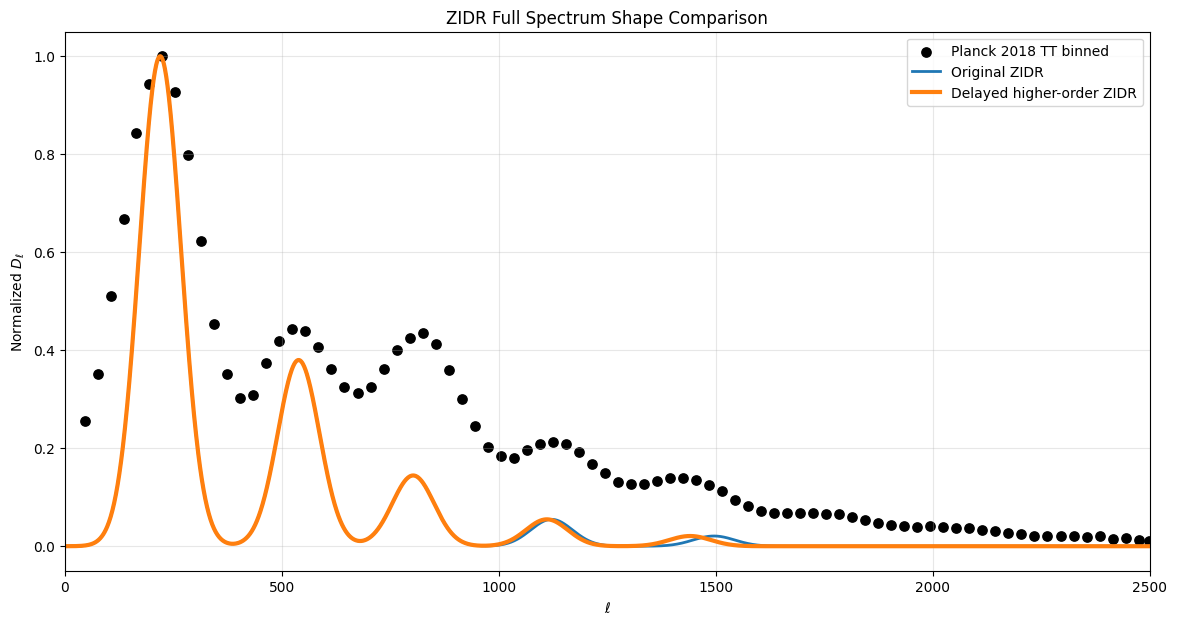
The CMB profile comparisons shown above were generated using the ZIDR Python computational framework. The complete implementation used to generate the numerical results is available for download:
Download Python ZIDR Framework – CMB Profile Comparison (.py)Zero-Infinity Dimensional Recursion (ZIDR) Conceptual Paper
Listen to Paper Summary Audio:
This paper introduces the Zero-Infinity Dimensional Recursion (ZIDR) model as a proposed alternative framework to standard Big Bang cosmology. Rather than describing the universe as originating from a singular event followed by expansion, ZIDR suggests that physical reality may emerge from a recursive dimensional structure that converges toward a zero-dimensional (0D) origin.
Drawing inspiration from aerospace and mechanical engineering, where system-level behavior arises from the interaction of multiple degrees of freedom, ZIDR interprets higher-dimensional structures as recursive accumulations of lower-dimensional components. Within this framework, “infinity” is treated as a limiting process that approaches a 0D state rather than an unbounded quantity. The 0D origin is understood not as a physical singularity, but as a limiting reference point of minimal dimensional extent and maximal structural convergence.
Gravity is reinterpreted as the tendency of higher-dimensional structures to compress toward this origin. The apparent expansion of the universe is attributed not to the growth of spacetime itself, but to the propagation of light through regions of varying dimensional density within a fundamentally static manifold. In this picture, redshift can be expressed heuristically as:
where ρD is the effective dimensional density along the photon path. Black holes are understood as natural dimensional transition regions (“gates”) in which matter undergoes structured dimensional reduction while preserving information.
The present work introduces heuristic mathematical expressions to illustrate the recursive structure underlying ZIDR. A complete formalization, including a full Lagrangian treatment and predictive framework, is deferred to future work. This paper serves as a conceptual foundation for exploring the mathematical consistency and physical implications of recursive dimensional cosmology.
Development and Peer-Review History
The ZIDR framework was initially formulated in February 2026 in the manuscript “Zero-Infinity Dimensional Recursion (ZIDR): A Conceptual Framework for a Static, Non-Expanding Universe.” The initial manuscript underwent external peer review at the Journal of Applied Mathematics and Physics (JAMP). The referee review identified specific mathematical and physical issues requiring further formalization, including the definition of the recursive manifold, dimensional density, photon propagation, topological structure, and the relationship between the recursive framework and four-dimensional spacetime.
The peer-review feedback informed the subsequent development and expansion of the ZIDR framework through later versions. Version 6.0 (August 2026) represents the current canonical public formulation, incorporating substantially expanded mathematical development, geometric dispersion modeling, CMB power-spectrum derivation, numerical analysis, and proposed observational tests.
Important: Version 6.0 is publicly released as a preprint for open scientific discussion and independent evaluation. The peer-review history described above refers to the initial ZIDR manuscript and does not imply that Version 6.0 itself has undergone peer review.
Download the Full Paper: Zenodo DOI Figshare DOI SSRN DOI
Major Cosmological Questions & ZIDR Perspectives
The Zero-Infinity Dimensional Recursion (ZIDR) framework offers alternative interpretations of several unresolved problems in modern cosmology. Rather than describing the universe as originating from a singular Big Bang followed by expansion, ZIDR proposes that physical reality emerges from a recursive dimensional structure converging toward a zero-dimensional (0D) origin.
The modern standard model of cosmology (ΛCDM) is currently facing an operational crisis, highlighted by the intractable Hubble Tension and the recent discovery of mature, massive galaxies by the James Webb Space Telescope (JWST) that violate standard cosmic timelines. While standard cosmology attempts to resolve these anomalies by tuning parameters like dark energy, the ZIDR framework provides an alternative, non-expanding geometric architecture that naturally absorbs these observations. By treating the universe as a static, infinite-dimensional manifold converging toward a 0D origin, phenomena such as cosmological redshift and gravitational attraction emerge inherently from recursive dimensional traversal and compression, bypassing the conceptual necessity for a Big Bang singularity.
-
Cosmic Expansion
Standard View: The universe has been expanding since the Big Bang, with its current acceleration attributed to dark energy.
ZIDR Perspective: There may be no physical expansion of spacetime. Observed redshift could arise from light traversing a recursive dimensional structure with varying density.
Implication: Cosmological redshift may reflect properties of dimensional traversal rather than metric expansion. The Big Bang may not be necessary as a foundational event.
-
Dark Energy
Standard View: Dark energy is a hypothetical component driving the accelerated expansion of the universe.
ZIDR Perspective: Apparent acceleration may emerge from how light and gravitational fields behave within a recursive dimensional structure.
Implication: Dark energy could represent an observational effect of underlying geometry rather than a fundamental component.
-
Dark Matter
Standard View: Dark matter is an unseen form of matter inferred from gravitational effects on visible structures.
ZIDR Perspective: Gravitational anomalies may arise from interactions across higher-dimensional layers within the recursive structure.
Implication: Effects attributed to dark matter may instead reflect geometric properties of dimensional recursion.
-
Weakness of Gravity
Standard View: Gravity is the weakest fundamental force, with no complete explanation for its relative weakness.
ZIDR Perspective: Gravity may be a projected effect of higher-dimensional compression into observable space.
Implication: Its apparent weakness could result from dilution across dimensional layers rather than intrinsic force strength.
-
Large-Scale Structure
Standard View: The cosmic web forms through gravitational amplification of early density fluctuations.
ZIDR Perspective: Structure may emerge naturally from recursive, fractal-like dimensional layering.
Implication: Filaments and voids could reflect geometric recursion rather than purely dynamical evolution.
-
Redshift–Distance Relation
Standard View: Hubble’s law links redshift to distance through expansion.
ZIDR Perspective: Redshift may reflect traversal through varying dimensional densities (z ∝ ΔρD, where ρD is effective dimensional density).
Implication: Distance–redshift relationships could encode properties of dimensional structure rather than expansion history.
-
Black Holes and Information
Standard View: Singularities, Hawking radiation, and unresolved information paradoxes. Ultra-massive black holes require implausibly high accretion rates within 13.8 billion years.
ZIDR Perspective: Black holes may be dimensional transition regions where matter undergoes stepwise reduction toward the 0D origin while preserving information. Hawking radiation is the byproduct of shed dimensional layers.
Implication: This framework could remove singularities, resolve the information paradox, and allow natural formation of supermassive black holes over much longer timescales in an eternal universe.
-
Early Galaxies and JWST Observations
Standard View: Observations of massive early galaxies and black holes challenge formation timelines but remain within the ΛCDM framework.
ZIDR Perspective: Structure formation may not be constrained by a single cosmic timeline. Recursive dimensional layering could allow complex structures to emerge across different depths.
Implication: “Early” structure may be reinterpreted as a projection effect rather than rapid formation in a young universe.
-
Quantum Entanglement
Standard View: Entangled particles exhibit correlations that appear non-local.
ZIDR Perspective: Particles may share a common 0D coordinate within the recursive structure, making apparent non-locality a projection effect.
Implication: Entanglement could reflect underlying geometric unity rather than faster-than-light interaction.
&⚡ Big Picture
If validated, the ZIDR framework would represent a significant shift in the interpretation of physical reality:
- The Big Bang and cosmic expansion may not be required as foundational explanations.
- Dark matter and dark energy could be replaced by geometric effects of recursion.
- Gravity may emerge as a dimensional projection rather than a fundamental force.
- Large-scale structure could arise from recursive geometry.
- Redshift may reflect dimensional traversal rather than expansion.
- Quantum entanglement could be explained through shared origin structure.
- Black holes may preserve information through dimensional transitions.
- Observational tensions (e.g., JWST results) could be naturally accommodated.
- The universe may be static, eternal, and structurally self-consistent.
In this view, physical laws are emergent properties of an underlying recursive dimensional architecture. ZIDR proposes a fundamental reinterpretation of space, time, matter, and information within a geometric framework.
References
- • Kaluza, T. (1921). Zum Unitätsproblem der Physik. Sitzungsberichte der Preußischen Akademie der Wissenschaften, 966–972.
- • Witten, E. (1995). String Theory Dynamics in Various Dimensions. Nuclear Physics B, 443(1–2), 85–126. doi:10.1016/0550-3213(95)00158-8
- • Maldacena, J. (1998). The Large N Limit of Superconformal Field Theories and Supergravity. Advances in Theoretical and Mathematical Physics, 2(2), 231–252. doi:10.4310/ATMP.1998.v2.n2.a4
- • Einstein, A. (1917). Kosmologische Betrachtungen zur allgemeinen Relativitätstheorie. Sitzungsberichte der Preußischen Akademie der Wissenschaften, 142–152.
- • Verlinde, E. (2011). On the Origin of Gravity and the Laws of Newton. Journal of High Energy Physics, 2011(4), 29. doi:10.1007/JHEP04(2011)029
- • Gupta, R. P. (2023). JWST early Universe observations and ΛCDM cosmology. MNRAS, 523(3), 3385–3395.
- • Naidu, R. P. et al. (2022). Two remarkably luminous galaxy candidates at z ≈ 10–12 revealed by JWST. ApJL, 940(1), L14.
- • Finkelstein, S. L. et al. (2022–2024). CEERS/JADES JWST observations.
- • Lovyagin, N. et al. (2022). Cosmological Model Tests with JWST. arXiv:2212.06575.